While users certainly have their phones and tablets turned on as they watch TV, there hasn’t been a killer second-screen app to gather them all. There are some good contenders, however:

While users certainly have their phones and tablets turned on as they watch TV, there hasn’t been a killer second-screen app to gather them all. There are some good contenders, however:
Spending  on consumer electronics is expected to top $250 per shopper this holiday season and, according to the Consumer Electronics Assn., 76% of gift-giving adults plan to give a gadget as a present. That doesn’t mean finding the right item is an easy task, though. To help out, Variety offers up a few ideas that are bound to please even the most discriminating tech-lover.
When  the standards for local wired high-speed computing networks were first formalized in 1985, streaming media wasn’t a big concern. But as demand for those services has increased, especially in recent years, officials have begun to fear a logjam, so they have taken steps to prepare for a expected flood of streaming and downloaded multimedia in the years to come.
The Institute of Electrical and Electronics Engineers (IEEE) recently upgraded Ethernet standards, increasing bandwidth speeds and preparing for new markets, including in-car networking.
The 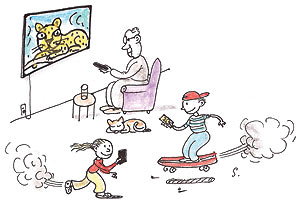 history of mobile television has been rocky at best. While the allure of streaming live network programming to viewers over their handheld devices is undeniable, delivering that content in ways that don’t abrogate rights agreements and can somehow be monetized has proven mercurial. Loudly trumpeted efforts have fallen short, victims of poor design decisions, overpriced services and/or confusion about the target audience.
While the idea of watching television on a 3.5″ screen might not make sense to anyone in their mid-30s or older, mobile TV is a logical extension of how Generation Me has grown up with entertainment. It’s also a way for broadcasters to reclaim some of the younger viewers who increasingly spend free time multitasking with their handheld devices and may be staying away from TV sets entirely.
Oct.  5 marks the first anniversary of Steve Jobs’ death. And in the past year, the financial world — mindful of Jobs’ obsession with detail and ability to drive the Apple staff to innovative heights — has wondered about the company’s prospects without him. That also applies to Disney and Pixar. Apple may have been Jobs’ favorite child, but Disney (where he was the largest single shareholder after the company’s 2006 merger with Pixar) was a close second.
In the short-term, things are soaring. Disney shares are up roughly 70% since Jobs’ passing, while Apple has jumped 86%. Both companies work several years in advance on products and strategies, meaning Jobs’ fingerprints will be on upcoming releases for a fair bit longer (if only tangentially).
The  resurgence of 3D in theaters and the growing number of 3D-capable TVs has dusted off an axiom in Hollywood: Everything old is new again.
Several studios are digging deep into their libraries to bring both recent hit films back for second theatrical runs in 3D and reviving old classics for 3D home conversions. And the trend isn’t showing any sign of slowing down.
For 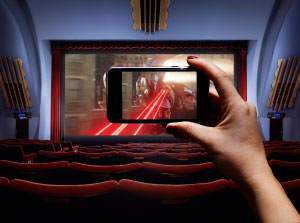 theater owners (and studios), cell phones and tablets are the enemy today, distracting, and often angering, filmgoers. But a contingent of entertainment industry executives sees potential in the second screen inside movie theaters — and says it won’t be long before cinema chains agree.
“Cinemas have changed over the years, from being privately owned one-off, one-screen affairs to multiplexes owned by major corporations,” says Peter Wilson, director of High Definition and Digital Cinema. “They’re a bean counter-led business, where every square centimeter has to make money.”
Over  the past 10 years, the “Resident Evil” franchise has raked in more than $700 million for Constantine Film — but if Paul W.S. Anderson’s childhood vacations had been more interesting, it might never have made a nickel.
Every summer, his grandparents would take him to a “grim” resort in England, where the only real entertainment for kids was the local arcade. For a long time, that simply meant pinball, but one day he walked in to find “Space Invaders” — and Anderson was hooked.
When 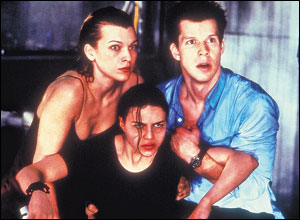 “Resident Evil: Retribution” hit theaters Sept. 14, many of its faces no doubt looked familar — to fans of both the films and games.
The fifth installment in this 10-year-old franchise ranks as its most ambitious. And to ensure success, writer-director Paul W.S. Anderson tapped deep into the game and film’s mythology, assembling a who’s who of characters.
“Resident  Evil” is an abstraction in the film world.
It’s a franchise based on a videogame that not only has found an audience, but also continued to build on it with each release. That’s a feat “Tomb Raider” couldn’t manage, even with Angelina Jolie filling out Lara Croft’s short shorts.
 Chris Morris: Journalist